

If you've been looking for a more natural or fluoride-free way to care for your teeth, you may have come across hydroxyapatite toothpaste.
Once relatively unknown in the UK, hydroxyapatite is becoming an increasingly popular ingredient in oral care. But what exactly is it? How does it work? And how does hydroxyapatite toothpaste compare with the conventional fluoride toothpaste most of us grew up using?
Here we take a closer look at the science behind hydroxyapatite and some of the reasons you might consider making the switch.
What is hydroxyapatite?
Hydroxyapatite – sometimes abbreviated to HAp or HA – is a naturally occurring mineral made primarily from calcium and phosphate.
What makes it particularly interesting for dental care is that hydroxyapatite is already a major mineral component of our teeth and bones. Tooth enamel is predominantly composed of mineral apatite, so hydroxyapatite has a structure that closely resembles the material our teeth are made from.
When used in toothpaste, hydroxyapatite particles can interact with the surface of the tooth and deposit mineral onto areas where enamel has begun to lose minerals.
This is why you'll sometimes hear hydroxyapatite described as a biomimetic ingredient: rather than simply cleaning the teeth, it uses a material that mimics their natural mineral structure.
How does hydroxyapatite toothpaste work?
Our tooth enamel is incredibly strong, but it is subjected to challenges every day.
Acids produced by plaque bacteria and acidic foods and drinks can cause minerals to be lost from the enamel – a process known as demineralisation.
Saliva naturally helps to counteract this process by supplying minerals back to the tooth. This is known as remineralisation.
Hydroxyapatite toothpaste is designed to support that natural process. The hydroxyapatite particles can adhere to the tooth surface and provide calcium and phosphate-containing mineral where it is needed.
Research into hydroxyapatite oral-care products has found evidence supporting their use for enamel remineralisation and reducing tooth sensitivity.

What are the benefits of hydroxyapatite toothpaste?
1. It can help remineralise tooth enamel
One of the main reasons people choose hydroxyapatite toothpaste is its ability to support the remineralisation of enamel.
Rather than being a harsh or abrasive treatment, hydroxyapatite works by depositing tooth-like mineral onto the enamel surface.
A 2025 systematic review and meta-analysis comparing fluoride-free hydroxyapatite toothpastes with conventional fluoride toothpastes found no significant difference in the development or progression of caries lesions between the two groups in the studies analysed. The researchers concluded that hydroxyapatite could be an effective alternative for preventing caries progression and promoting enamel remineralisation.
2. It may help with sensitive teeth
Do you get a sudden twinge when you drink something cold or eat something sweet?
Sensitivity can occur when the underlying dentine becomes exposed. Dentine contains tiny channels called dentinal tubules that can transmit stimuli towards the nerve inside the tooth.
Hydroxyapatite particles can help occlude – or block – these exposed tubules, potentially reducing sensitivity.
A systematic review and meta-analysis of clinical trials found that hydroxyapatite-containing oral-care products significantly reduced dentine hypersensitivity.
So hydroxyapatite toothpaste may be particularly interesting if you're looking for everyday oral care that also supports sensitive teeth.
3. It provides a fluoride-free option
Most conventional toothpastes use fluoride as their main active ingredient for protecting against tooth decay.
Fluoride has decades of research supporting its effectiveness, so there's no need for most people to avoid it.
However, some people actively prefer fluoride-free oral care. Hydroxyapatite provides an alternative that doesn't simply remove fluoride and leave nothing in its place – it supplies another active mineral ingredient designed to support the teeth.
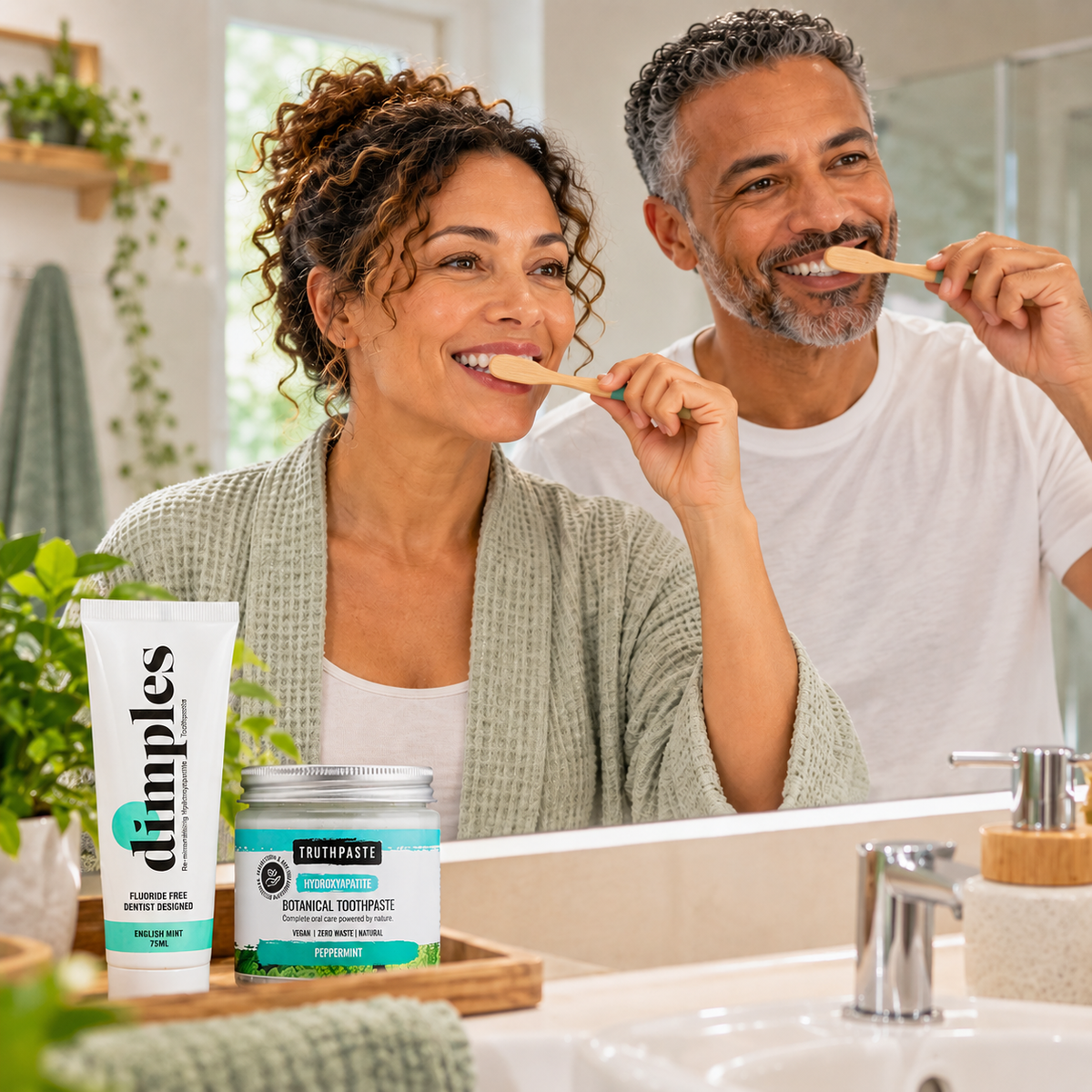
Both the Dimples Hydroxyapatite Toothpaste and Truthpaste Hydroxyapatite Toothpaste available from FISA Health are fluoride-free, and also have child friendly versions too.
4. It works with a mineral naturally found in teeth
One of hydroxyapatite's biggest attractions is its biomimetic nature.
Because hydroxyapatite is closely related to the mineral naturally present in teeth, it can interact directly with enamel and dentine rather than acting solely as a cleaning ingredient.
This is also why hydroxyapatite has applications beyond toothpaste and has been investigated extensively in dentistry and biomaterials.
5. It may help teeth look smoother and brighter
Hydroxyapatite isn't a bleaching agent.
However, depositing mineral onto microscopic irregularities in the enamel surface may create a smoother tooth surface, which can affect the way light reflects from the teeth.
So it's better to think of this as supporting the natural appearance of your enamel rather than chemically bleaching your teeth.
Hydroxyapatite vs fluoride toothpaste – what's the difference?
The two ingredients take somewhat different approaches.
Fluoride helps make enamel more resistant to acid attack and supports remineralisation, and fluoride toothpaste remains the conventional benchmark for preventing tooth decay.
Hydroxyapatite, meanwhile, supplies tooth-like calcium-phosphate mineral that can deposit on the enamel surface and within exposed dentinal tubules.
Research comparing the two is encouraging. Recent systematic reviews have found hydroxyapatite toothpastes can perform comparably with fluoride toothpastes in some measures of caries prevention and remineralisation. However, fluoride has been studied for much longer and has a substantially larger body of evidence behind it.
So rather than saying that hydroxyapatite is simply "better than fluoride", we'd describe it as a promising fluoride-free alternative for people who specifically want one.
What about nano-hydroxyapatite and micro-hydroxyapatite?
You may see products referring to nano-hydroxyapatite (nHAp) or micro-hydroxyapatite.
This refers to the size of the hydroxyapatite particles used in the formulation.
Smaller particles can interact with microscopic features of the tooth surface and dentinal tubules. However, that doesn't mean you should automatically assume that any product labelled "nano" is superior – concentration, formulation and particle characteristics all matter.
Interestingly, a 2026 systematic review comparing nano-hydroxyapatite and fluoride for dentine hypersensitivity found that nano-hydroxyapatite produced greater reductions in some sensitivity measures after two weeks, although fluoride performed better for cold-air sensitivity at eight weeks. The authors concluded that nano-hydroxyapatite may be particularly useful as a rapid-acting desensitising ingredient, while also noting limitations in the available studies.
Which hydroxyapatite toothpastes can I try?
At FISA Health, we stock hydroxyapatite toothpaste from Dimples and Truthpaste, giving you different options depending on the type of formulation you prefer. Both provide children's toothpastes too, and Truthpaste offer a travel version as well.

Dimples Hydroxyapatite Toothpaste
Dimples Hydroxyapatite Toothpaste is a fluoride-free, dentist-designed toothpaste created to support remineralisation while providing everyday cleaning.
The 75ml tube is designed to last one person approximately 6–8 weeks when used twice daily with a pea-sized amount, making it an easy swap for your regular toothpaste.
Shop Dimples Hydroxyapatite Toothpaste at FISA Health

Truthpaste Hydroxyapatite Toothpaste
Truthpaste Hydroxyapatite Toothpaste takes a slightly different approach. Its peppermint formulation contains 5% micro-hydroxyapatite, alongside organic botanicals.
It's also free from fluoride, SLS, artificial sweeteners and artificial flavours, making it a particularly appealing option for people looking for a more natural approach to their oral-care routine.
Shop Truthpaste Hydroxyapatite Toothpaste at FISA Health
Should I switch to hydroxyapatite toothpaste?
There's no single toothpaste that's right for everybody.
If you're happy using fluoride toothpaste, there is strong evidence for continuing to do so. But if you've been looking for a fluoride-free toothpaste that still contains an active ingredient to support enamel, hydroxyapatite is an interesting option.
It may be particularly worth considering if you:
- want a fluoride-free toothpaste
- experience tooth sensitivity
- want to support enamel remineralisation
- prefer biomimetic oral-care ingredients
- are looking for an alternative to a conventional toothpaste formulation
People with frequent tooth decay, gum disease, significant sensitivity or other dental problems should speak to their dentist before changing their oral-care routine.
A new approach to everyday oral care
Hydroxyapatite toothpaste isn't simply another "natural toothpaste" trend. There is a growing body of clinical research investigating its ability to remineralise enamel, help prevent caries and reduce tooth sensitivity.
By using a mineral closely related to the material our teeth are naturally made from, hydroxyapatite offers a different approach to looking after your smile – and, for those who want to avoid fluoride, an increasingly well-researched alternative.
Ready to give it a try? Explore our range of Dimples and Truthpaste oral-care products at FISA Health.

Share:
Which Supplements Help Support Healthy Joints?
The Mouth–Gut Connection: Why Digestive Wellbeing Starts With Understanding Your Mouth